
Two sensors, two different questions
A PIR sensor answers "did something warm move past me". A Time of Flight sensor answers "what shapes are below me and which way is each one going". Both get sold as people counters, and both are legitimate, but they solve different problems at different price points. Ariadne ships both classes of hardware, so this comparison has no side to take: the honest answer is that the right sensor depends on the door.
Which is better for people counting, ToF or PIR?
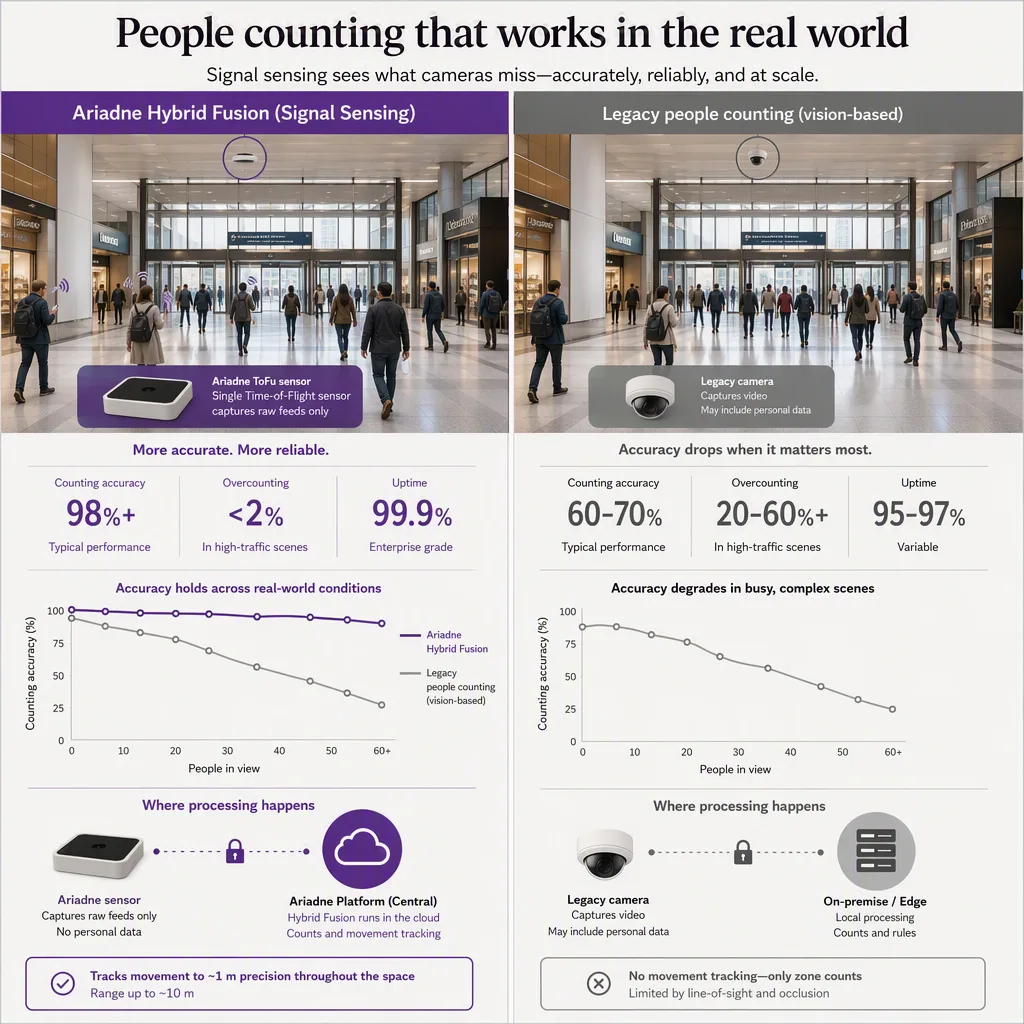
For busy entrances where accuracy drives decisions (conversion rates, staffing, tenant reporting), ToF wins: it separates side-by-side entries, ignores shadows, and holds its accuracy under crowding. For low-traffic passages where a power socket is a luxury and a rough directional count is enough (back corridors, secondary doors, remote sites, portable installations), a dual-PIR counter wins on cost, battery life, and installation speed. Most estates need both.
How each one works
PIR (passive infrared) detects the change in infrared radiation when a warm body crosses its field of view. It emits nothing, which is why it runs for years on batteries. A single PIR element knows only that something passed; a dual-PIR counter adds a second element so the firing order reveals direction, in or out. What it cannot do is resolve how many warm bodies passed together: a couple walking abreast is one event.
ToF actively illuminates the scene with infrared pulses and times the reflections, producing a live depth image in which each person is a distinct three-dimensional silhouette. Two people together are two silhouettes. The mechanics are in the pillar explainer.
The trade-offs, laid out
| Dual-PIR counter | ToF counter | |
|---|---|---|
| Power | Battery, years of life | Wired (typically PoE) |
| Install | Minutes, no cabling | Cabled, positioned overhead |
| Direction | Yes (dual element) | Yes, per person |
| Group separation | No | Yes |
| Shadow/reflection immunity | Yes (heat-based) | Yes (depth-based) |
| Accuracy under crowding | Degrades | Holds |
| Cost per door | Low | Higher |
| Right at | Low-traffic doors, remote sites | Main entrances, KPI-grade counts |
The power question alone often decides: if there is no PoE run and no budget to pull one, the honest choices are battery PIR or nothing. That trade is covered in PoE vs battery people counters.
Mixing both in one estate
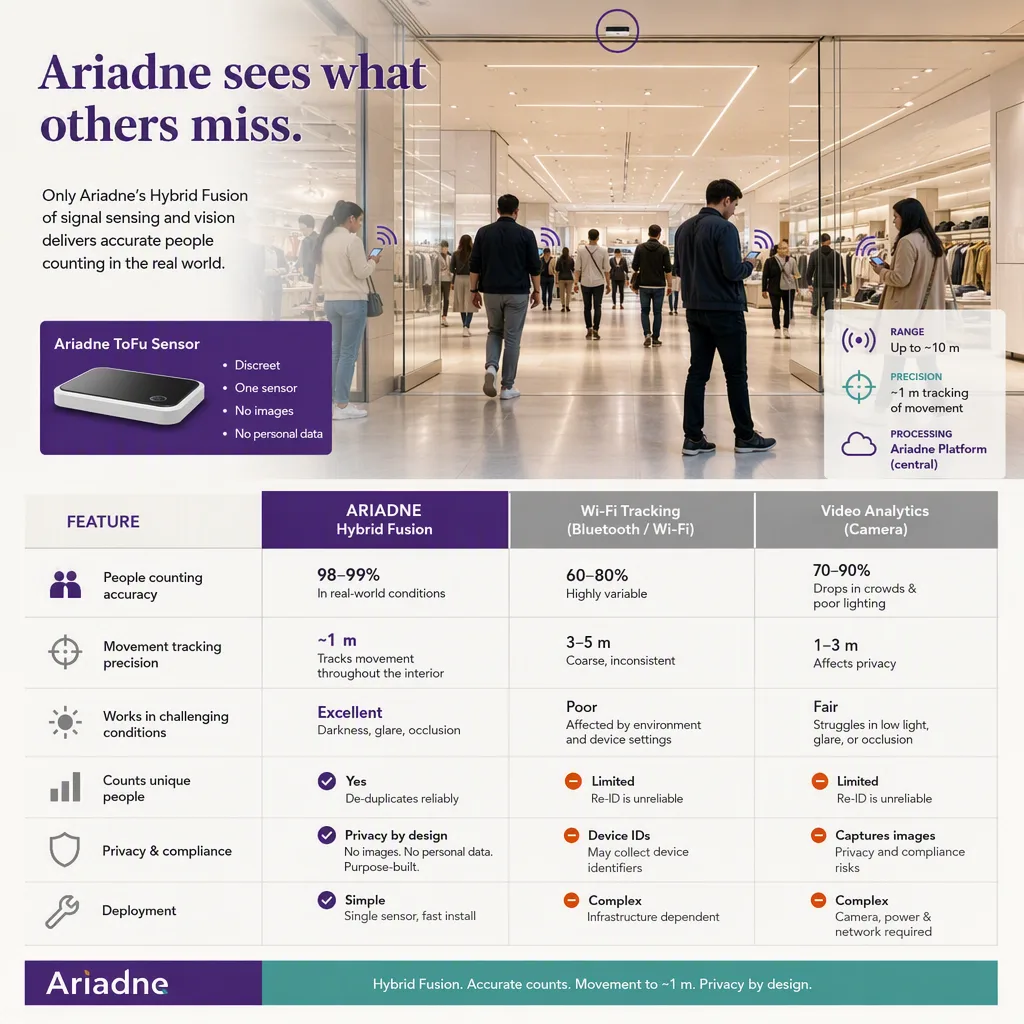
The pattern that works: ToF on the doors where the numbers feed decisions (the main entrance that defines footfall and conversion), PIR on the doors where you need presence and direction but nobody will ever defend the number in a board meeting. Ariadne's own hardware line reflects the split: the ToFu ToF sensor covers the accuracy-grade doors, and the Passage dual-PIR unit covers battery-only passages, with both feeding the same platform so the estate reports as one system.
If you are speccing a mixed estate, the buying checklist in the ToF people counter guide and the mounting notes in ceiling mount vs door frame counters are the two companion reads.
---


