
The same idea at two very different speeds
Strictly speaking, an ultrasonic sensor is also a time-of-flight device: it emits a pulse, waits for the echo, and converts the delay into a distance. The difference is the medium. Sound crawls at roughly 343 meters per second in air; light covers the same meter in about three nanoseconds. Everything that separates the two sensor families in practice (resolution, update rate, beam shape, cost) falls out of that speed gap and the wavelengths involved.
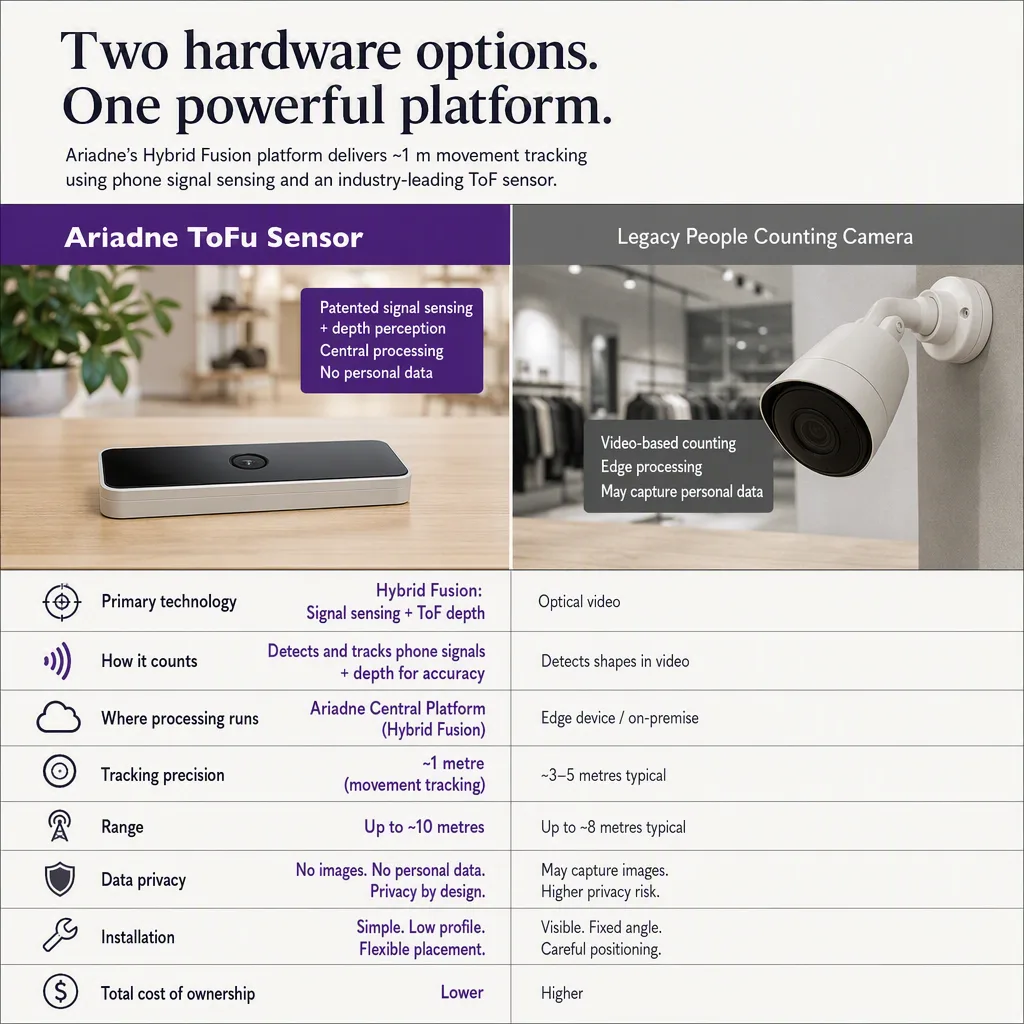
When should you use ultrasonic instead of optical ToF?
Use ultrasonic where the job is a single dependable distance to a large target and the environment is optically hostile: liquid level in a tank, a car in a parking bay, a loading dock. Ultrasonic does not care about transparent surfaces, fog, dust, or bright sunlight, all of which complicate optical sensing. Use optical ToF where you need many measurements at once, fast, with spatial detail: scene understanding, robotics, gesture input, and people counting.
What ultrasonic does well
- Optically difficult targets. Glass and clear liquids barely register for infrared light but reflect sound cleanly.
- Dirt tolerance. A dusty industrial environment that would blind an optical window still carries sound.
- Cost. Simple ranging at low unit cost, proven for decades in parking guidance and level measurement.
Where the physics runs out
An ultrasonic pulse spreads as a wide cone, so the sensor reports the nearest echo inside that cone with no idea what produced it. It cannot tell one person from two, cannot track direction on its own, and updates slowly because each measurement waits for a comparatively slow echo. Temperature shifts change the speed of sound and drift the calibration. For anything that needs the shape of a scene rather than a single distance, sound is the wrong instrument.
Why people counting settled on light
Counting requires exactly what ultrasonic lacks: multiple simultaneous measurements, fine lateral resolution, and a fast update rate, so that two people entering together register as two moving silhouettes rather than one echo. An overhead ToF sensor delivers a full depth frame of the doorway many times per second; the counting logic rides on top. The sensing chain is described in the pillar explainer, and the buyer-side view in the ToF people counter guide.
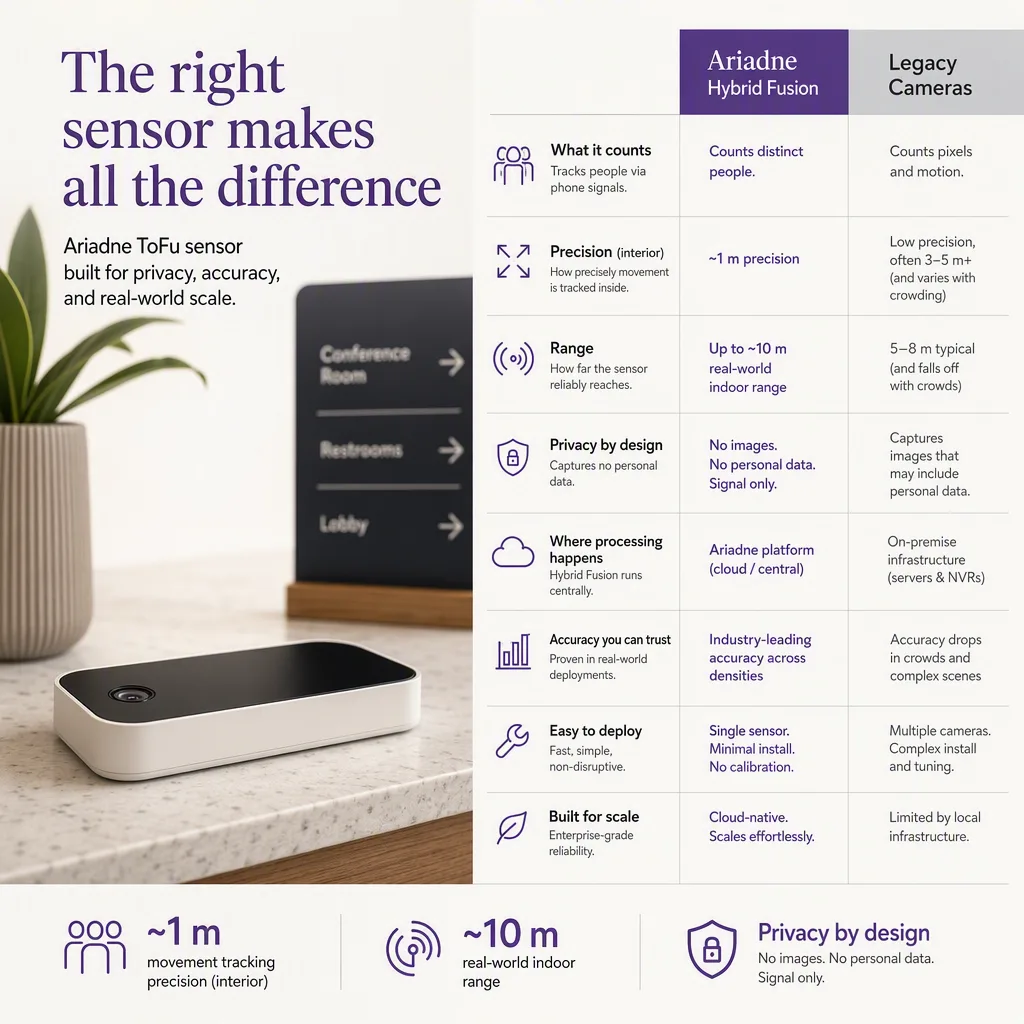
The two families coexist happily in the same building: ultrasonic guiding cars in the garage, ToF counting people at the doors above. Each one doing the job its physics is built for is the whole lesson of sensor selection.
---


