
Time of Flight vs LiDAR: the difference in one sentence
Time of Flight is a measuring principle: send light out, time how long it takes to come back, convert the delay into distance. LiDAR is a sensing system built on that principle, engineered for range and spatial coverage. Every LiDAR uses Time of Flight; almost no compact ToF sensor qualifies as a LiDAR. If you keep that hierarchy in mind, most of the confusion in vendor material resolves itself.
Is a ToF sensor the same as LiDAR?
No. A ToF sensor (or ToF camera) is typically a compact module that floods a short-range scene with infrared light and reads the reflections back on a small detector array, producing a depth image of everything in view at once. A LiDAR steers its light, historically with a spinning head, now often with solid-state beam steering, to scan large outdoor scenes at ranges of tens or hundreds of meters. Same physics, different machines, different jobs.
What both share
Both start from the same fact: light travels at a fixed speed, so a round trip time is a distance. Both emit their own light, usually near-infrared, so both work in complete darkness. Both return geometry rather than photographs, which is why neither produces an image a human could recognize a face in. For the underlying mechanics, the pillar explainer covers how a Time of Flight sensor works step by step.
Where LiDAR is the right tool
LiDAR earns its cost where range and field coverage dominate: autonomous vehicles reading a street, surveying and mapping, port and rail logistics, perimeter monitoring across open ground. The engineering that gets a usable return signal back from a target far away (powerful emitters, precise beam steering, sensitive detectors) is exactly what makes LiDAR units larger, hungrier, and more expensive than compact ToF modules. None of that investment pays back inside a doorway.
Where a ToF sensor is the right tool
Short range, wide field, high update rate, small housing, low power. A ToF depth sensor watching an entrance from overhead sees every person passing below as a moving silhouette in the depth image and never needs to resolve anything beyond a few meters. This is the class of device that counts people, measures queue lengths, and drives gesture interfaces. It is also the class that mounts discreetly on a ceiling and runs for years without maintenance.
The comparison, condensed
| Compact ToF sensor | LiDAR | |
|---|---|---|
| What it is | Depth sensor/camera module | Scanning sensing system |
| Typical range | Short, indoor scale | Tens to hundreds of meters |
| Output | Depth image of the whole scene per frame | Point cloud built by scanning |
| Size and power | Small, low | Larger, higher |
| Typical jobs | Counting, gestures, robotics near-field, dimensioning | Vehicles, surveying, wide-area monitoring |
| Produces images of people | No, geometry only | No, geometry only |
For what those outputs look like and how they differ, see depth maps vs point clouds.
Which one does people counting need?
Counting at an entrance is a short-range, fixed-scene problem, which is why the field settled on compact depth sensing rather than scanning LiDAR. Some crowd-analytics vendors do deploy LiDAR for large open plazas, and at that scale it can be the honest choice. At a door, it is an expensive way to do what a ToF sensor does better.
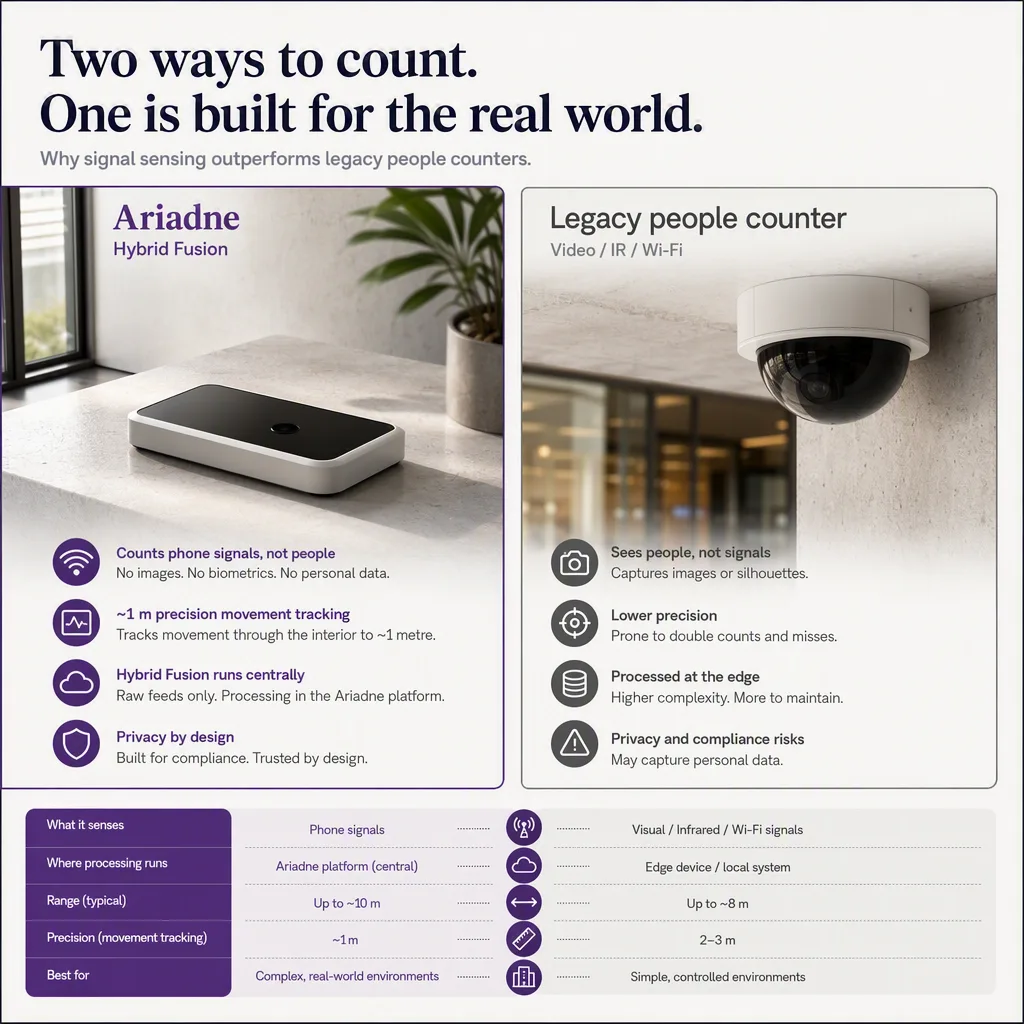
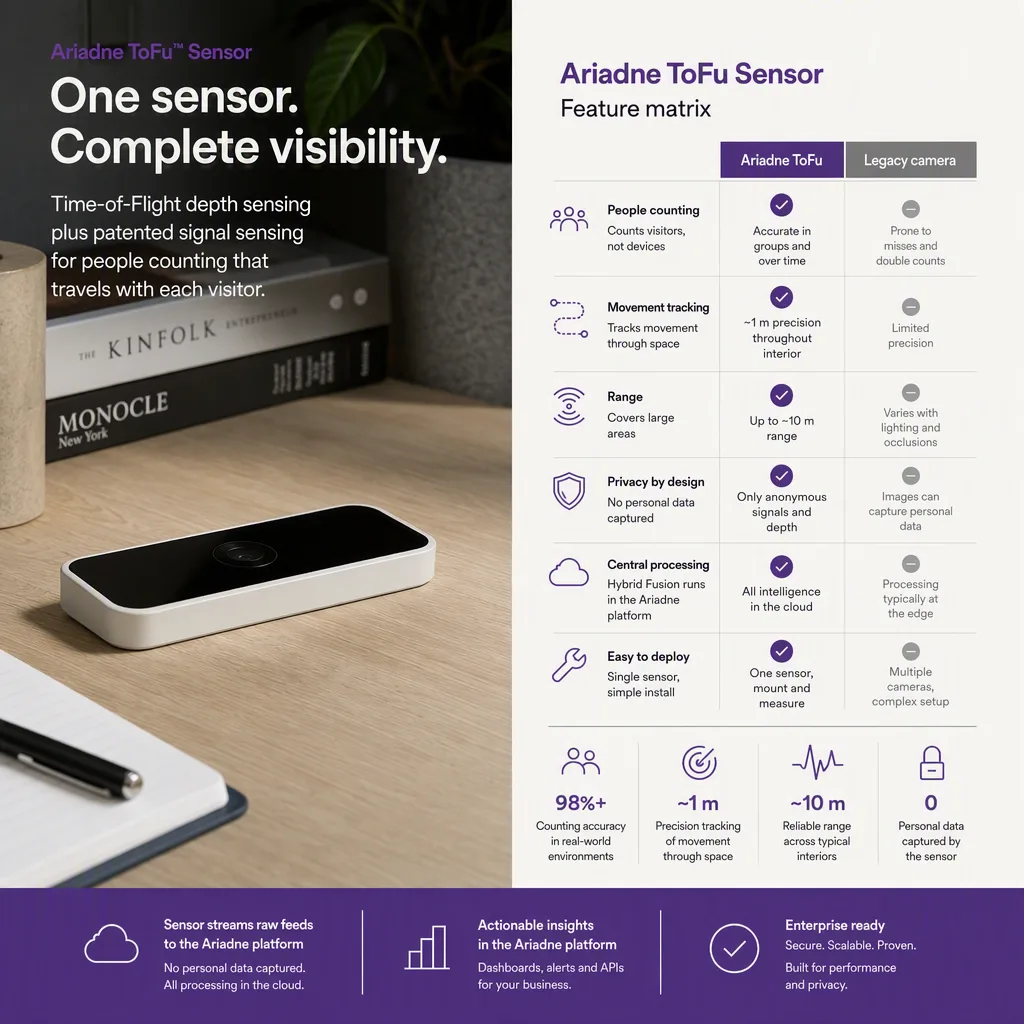
Ariadne uses ToF depth sensing at entries and exits as one half of its camera-free measurement method: the sensor captures geometry rather than images, counts every visitor regardless of whether they carry a phone, and feeds the platform where the full journey is assembled. If you are weighing sensor classes for a counting project, the honest comparison to read next is stereo vs ToF vs thermal sensors.
---


