
The sun is a competing emitter
A Time of Flight sensor works by seeing its own infrared light come back. Sunlight is an enormously powerful broadband emitter that includes the same infrared wavelengths, so an outdoor sensor is trying to hear its own echo while standing next to a waterfall. Indoors this problem barely exists, which is why ToF counting at interior doorways is uncontroversial. Outdoors, the physics has to be engineered around, and this post explains how.
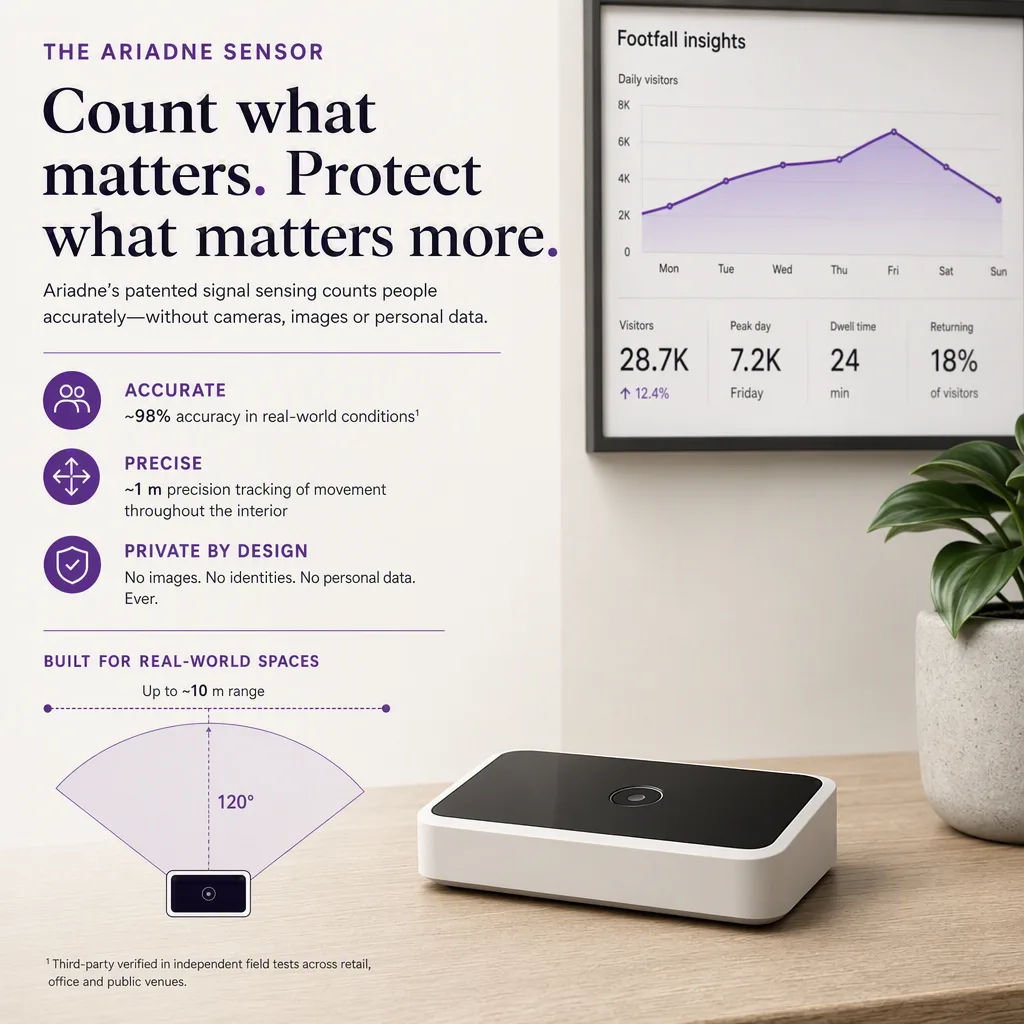
Do Time of Flight sensors work outdoors?
Yes, with design measures: wavelength selection around 940 nm where the solar spectrum has a natural dip, narrow optical bandpass filters that admit the sensor's own wavelength and reject the rest, higher emitter power, pulsed direct-ToF architectures that discriminate their own signal statistically, and mounting that shades the sensor from direct sun. An indoor-grade module pointed at a sunlit scene will lose range and gain noise; an outdoor-engineered device holds its specification.
What sunlight actually does to the measurement
Ambient infrared raises the noise floor on every pixel. The sensor's returning signal has to clear that floor to register, so effective range shrinks as ambient light grows: a sensor that resolves a person at several meters in a corridor may only manage a fraction of that in full sun. Noise also widens the spread of individual distance readings, so edges of objects shimmer and small depth differences blur. In the worst geometry, direct sun into the lens, pixels saturate and measure nothing at all.
The engineering countermeasures, ranked
- Wavelength choice. Atmospheric water vapor absorbs a slice of solar infrared around 940 nm, so emitters at that wavelength face less competition than at 850 nm. Most outdoor-capable designs live there.
- Optical filtering. A narrow bandpass filter in front of the detector rejects everything except the emitter's own wavelength. The narrower the filter, the less sun gets in.
- Architecture. Direct ToF's pulsed operation and photon-counting detectors separate signal from ambient statistically, one reason dToF designs dominate outdoor use. The split is explained in dToF vs iToF.
- Power and duty cycle. More emitter power raises the echo above the noise floor, bounded by eye-safety certification, which caps how hard any design can push.
- Mechanical shading. The unglamorous fix that rescues real deployments: a canopy, a north-facing mount, an angle that keeps direct sun off the optics.
What this means for counting projects
Interior doorways: no issue, the technology's home turf. Glass frontage with low evening sun: plan the mounting angle in the site survey. Fully outdoor gates, plazas, and pedestrian zones: specify outdoor-engineered hardware and expect the site survey to matter as much as the device choice; the use-case side of that story, including low-light scenarios, is covered in low-light and outdoor people counting.
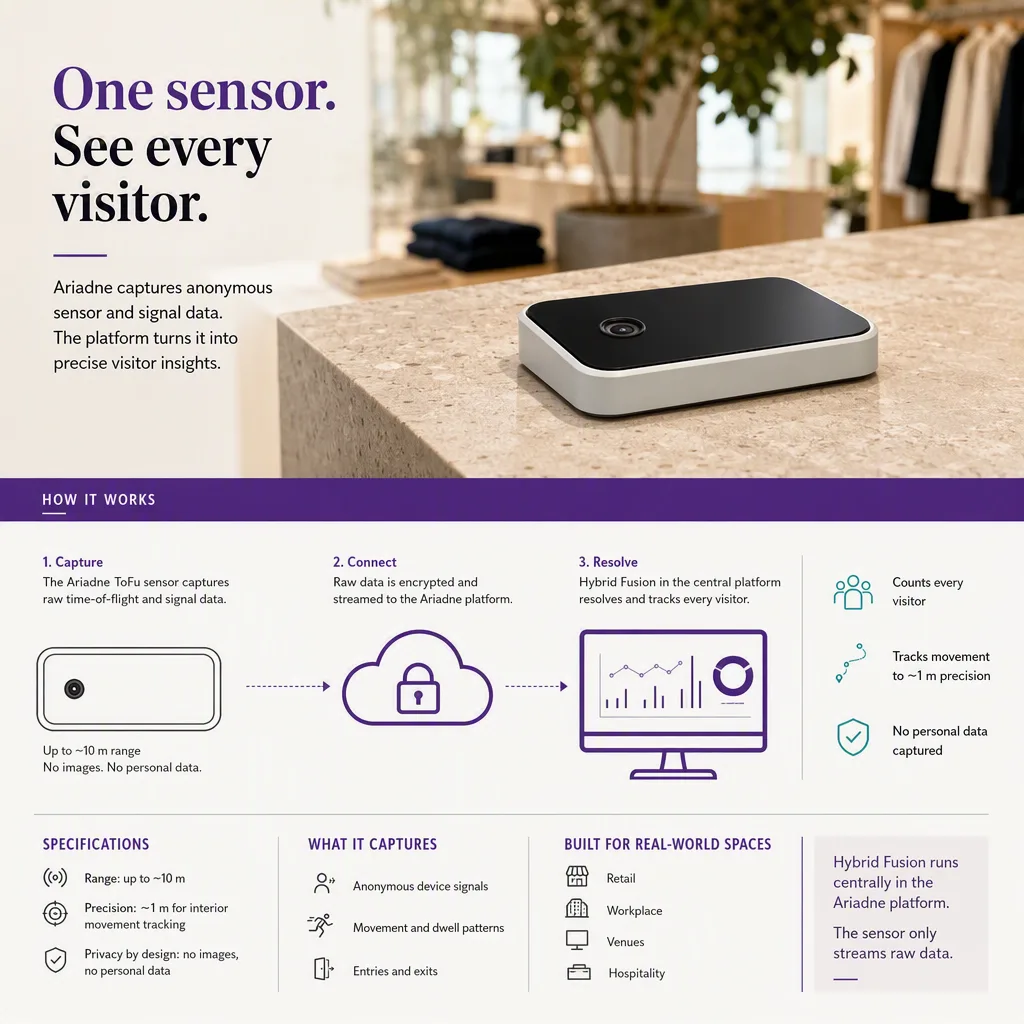
The rule of thumb that survives contact with real sites: sunlight is a solvable input, not a dealbreaker, but it is solved at specification time, not after installation. For the fundamentals underneath, see the pillar explainer.

---


