Marketing Manager
Sales Impacts of Employees Interacting with Customers
How much does employee interaction with customers help to close a sales deal? This was the question that leadership at furniture retailer asked Ariadne to help answer.
TARGETED ENVIRONMENT
The furniture retailer has a robust rug department and has dedicated employees to being present in the area to assist customers with questions and recommendations. Although there was an anecdotal understanding that more employees may translate to higher sales,there was no data showing a relationship between the two. Having an answer to this question could improve staffing schedules as well as have an impact on higher sales revenues.
PROJECT ENGAGEMENT
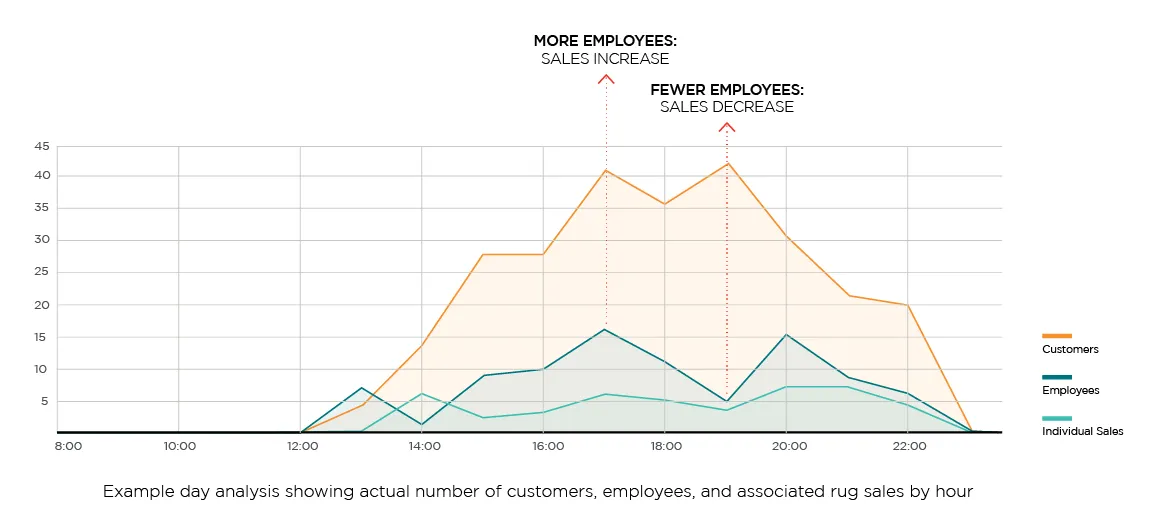
Using Ariadne’s small device sensors, the team placed monitors that focused only on the rug department to eliminate cross-over from other product areas. The sensors identified and quantified the total number of customers and employees in the department at any one time. The Ariadne team also collected sales numbers from the store during the test period for comparison purposes. The data shows a direct relationship between the number of employees available in the product department and subsequent rug sales. In the graph below, approximately the same number of customers were in the rug area at both 17:00 and 19:00. However, at 17:00 there were 16 employees present, and at 19:00 only 5 employees were present. Rug sales dropped despite a consistent number of customers, showing the employees’ impact of on customer purchases.
IMPACT OVER TIME
When examining the chart on the previous page, it becomes clear that the impacts to sales is dependent upon the number of employees present. The number of customers in the rug area varies throughout the day, but the increases and decreases in sales follow the same pattern of employee presence in the area.
On average, the data showed that when the area was at a 30% ratio of employee-to-customer count, sales were high, sustained, and measurable. When employee count dropped, so did sales.
While there is likely a margin of customers who are passing through the rug area on their way to another product section, the impact of the employee engagement on those who are rug shopping seems evident.
Though the graph in Figure 1 shows details from a single day, Ariadne had the opportunity to map engagements over a period of one month in order to show consistent data findings. By combining the ongoing data collection from the placed sensors with rug sales data which was provided by the store, Ariadne was able to compare employee presence, customer presence, and sales by specific hours of the day. Examining the month of July 1 - July 31, Ariadne conducted a deep dive into the patterns of employee presence and sales for the rug product area. The results were clear: when employees were highly present, sales were made 88.2% of the time. Sales were only made 12.5% of the time when an employee was not present in the rug area.
Using the same 30% employee-to customer ratio identified above and comparing it to both customer counts and sales data obtained from the store, Ariadne analyzed the data to see if the opposite were also true: would sales be lost if employees were not present in the rug area?
The findings were clear: 87% of the time a potential sale was lost, there was a low percentage of employees in the area or none at all. Only 13% of the time a sale was lost when the employee-to-customer ratio was at optimum. These numbers show an almost exact inverse impact of employees being present or not to sales occurring or not.
FINANCIAL IMPACT
The average price of an retailer rug is approximately €120. Given the average number of sales lost due to lack of employees in the area, it could have a financial impact of €42k in lost revenue for the store in the month of July and a loss of approximately €500k annually.
Download the full article now
More Case Studies
See how other organizations are leveraging Ariadne.